
A septic tank pumping cost usually falls between $250 and $500, and the EPA uses that band as its routine maintenance reference. The final septic tank pumping cost depends on three things: your tank, your access, and where the waste goes. A buried lid on a long hose run can double the visit.
This guide breaks a pump-out quote into the parts you can check. It also shows how to turn the price into a monthly reserve, so the visit never lands as a surprise.
What a septic tank pumping cost actually pays for#
A pump-out price covers a visit, not just a suction hose. Ask what the price includes before you compare two companies.
A standard visit usually covers four things:
- Locating and opening the tank lid
- Pumping every compartment of the tank
- Hauling the waste to a treatment facility
- Disposal fees at that facility
Many companies also rinse the tank walls and note the scum and sludge levels. Some charge for that step, and some include it. Ask.
An inspection is a separate service in most quotes. The inspector checks baffles, the effluent filter, the inlet and outlet, and the drainfield. It takes longer than a pump-out and costs more.
What the price usually leaves out#
A septic tank pumping cost covers the tank, not the whole system. Four common items sit outside the headline number.
- An inspection of the baffles, filter, pipes and drainfield
- A repair found during the visit, such as a broken baffle
- A new riser to bring the lid to grade
- A second tank, such as a pump chamber on an alternative system
Ask each company to list these items as separate lines. A quote with clear lines is easier to compare than a single total.
The same logic applies to a weekend or holiday call. Emergency work often carries a premium because the crew is off schedule.
Why two quotes for the same tank differ#
Septic tank pumping cost varies because the work varies. Two companies can quote the same tank and mean different jobs.
| What changes | Why it matters | Effect on price |
|---|---|---|
| Tank size | More liquid means more hauling | Higher for 1,500 gallons than 1,000 |
| Access | A buried lid takes time to find and open | Higher when the lid sits under soil or a deck |
| Hose distance | A long run from truck to tank slows the job | Higher past about 100 feet |
| Disposal site | Local tipping fees differ by county | Higher where fees are high |
| Extras | Rinsing, filter cleaning, a second compartment | Each extra is usually a line item |
A low septic tank pumping cost can exclude disposal. That is the most common surprise on a final invoice. Ask one question: does the total include hauling and disposal?
{{IMG1}}
How disposal shapes the price#
Pumping removes liquid, and that liquid has to go somewhere. Most crews haul it to a municipal treatment facility and pay a tipping fee per gallon.
Two things follow from that. A larger tank means more gallons to haul and a higher fee. A county with expensive disposal raises every quote in that county.
Distance matters too. A long drive to the treatment plant adds time and fuel to the visit. Companies usually fold that cost into the price rather than list it.
Ask where the waste goes. In a county with high disposal fees, the septic tank pumping cost rises for every household. A company that names the facility and includes the fee is easier to trust than one that stays vague.
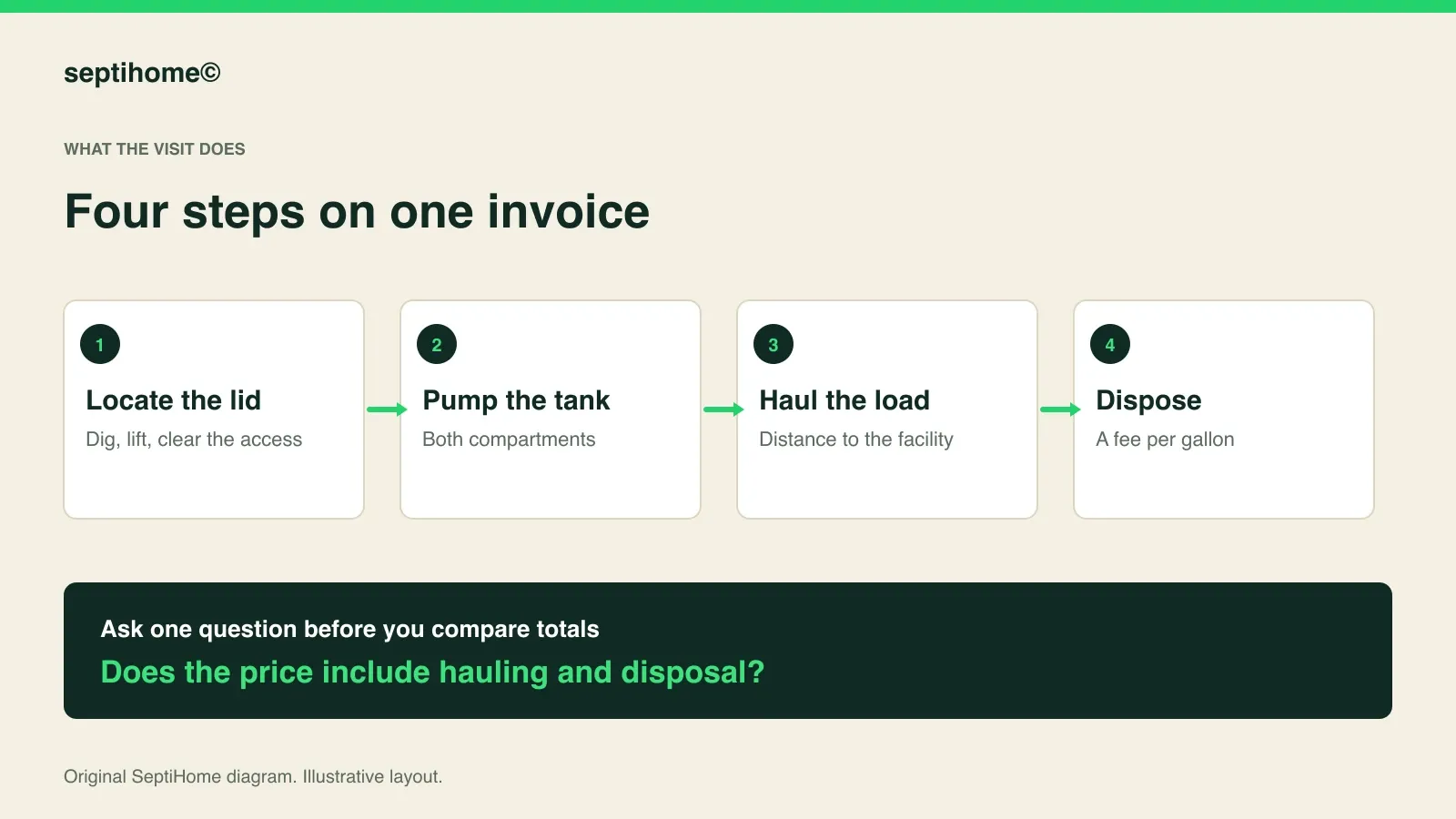 Four steps of a septic pump-out visit on one invoice
The three-number check before you book#
Use a short framework before you accept any quote. We call it the three-number check, and it takes one phone call.
- The visit price. Ask for the total for your tank, including access.
- The disposal line. Confirm that hauling and tipping fees sit inside that total.
- The access assumption. Ask what happens if the lid is buried or the tank is under a deck.
If a company cannot answer all three on the phone, keep calling. A written estimate should repeat the same three numbers.
This check matters because the cheapest quote is often the one with the most assumptions. The three-number check turns those assumptions into visible lines.
What raises a septic tank pumping cost#
Some jobs cost more for reasons you cannot control. Others come from choices you can still change.
- A lid under soil, turf or a deck adds digging time.
- A two-compartment tank takes longer than a single chamber.
- A pump tank adds a second vessel to empty.
- An emergency call on a weekend carries a premium.
- A long hose run across a lawn slows the crew.
Two habits lower the bill. Keep the lid visible, and book the visit before the tank is full. A raised riser costs money once and saves access time on every visit after that.
How often you pay it#
The EPA gives homeowners a clear starting point. It says a typical household should inspect the system every one to three years and pump the tank every three to five years.
That range is not a fixed rule. Household size, water use, tank size and the amount of solids all move the interval. A family of six fills a tank faster than a couple in the same house.
Build a schedule from your own dates with the maintenance planner. It keeps pumping and inspections on separate lines.
Alternative systems need more attention. A system with a pump, float switches or mechanical parts generally needs an annual inspection.
A worked example: 1,250 gallons and a buried lid#
Picture a 1,250-gallon concrete tank with two compartments. The lid sits under two inches of soil, and the truck parks about 60 feet away. This is a common layout in older suburban homes.
The visit includes four priced parts:
- Pumping both compartments
- Locating and uncovering the lid
- Hauling and disposal
- Replacing the soil and turf afterward
This is an illustrative example, not a quote from a contractor. Use your own written estimates and label the parts the same way.
A written estimate for this layout should show each part. If the total is a single number, ask the company to break it down before you compare it with another quote.
A second company may quote a lower total and exclude disposal. The three-number check catches that difference before you book, not after.
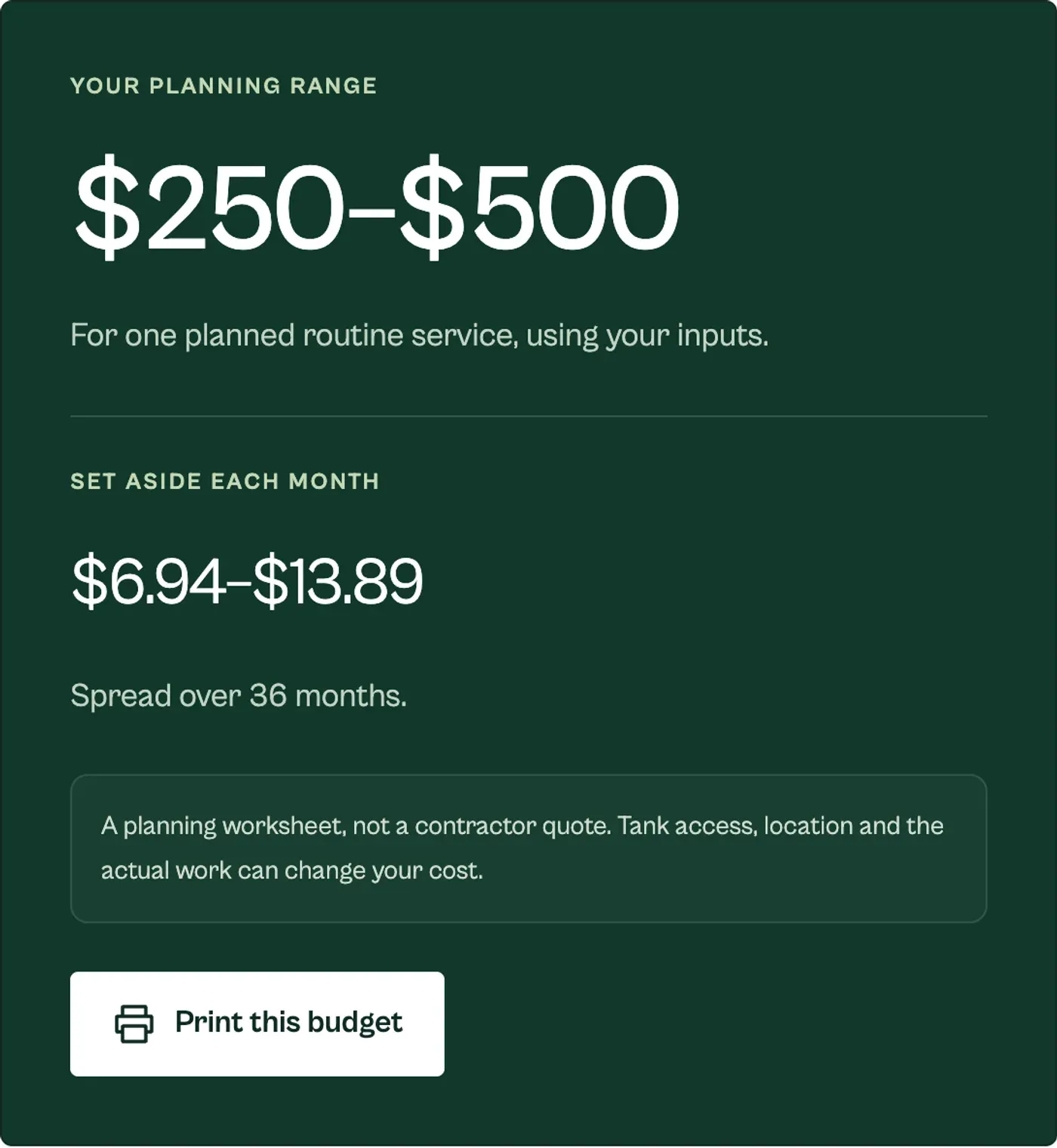 Cost planner result showing 6.94 to 13.89 dollars a month
Our cost planner turns those inputs into a monthly figure. Enter a low and a high estimate, add any confirmed extras, and choose the years between services.
{{IMG2}}
How to compare two written estimates#
Two estimates are only comparable when they cover the same work. Use the same checklist for each one.
- Tank size and number of compartments
- Lid access and any digging
- Pumping, hauling and disposal
- Tank rinse and filter cleaning
- Inspection, if you asked for one
Put the answers side by side. The lower total often loses once the missing lines appear.
A company that answers all five items in writing is giving you a real quote. One that answers two is giving you a starting price.
Turn the quote into a monthly reserve#
A septic tank pumping cost is a planned expense, not an emergency. Spread over 36 months, a $250 to $500 visit becomes about $7 to $14 a month.
That monthly number does more than smooth the bill. It makes the decision easier when a company offers a bigger service. You can see what the extra work costs per month.
The planner prints a budget you can keep with your service records. It also shows the assumptions behind the total, so a future quote can be checked against them.
{{IMG3}}
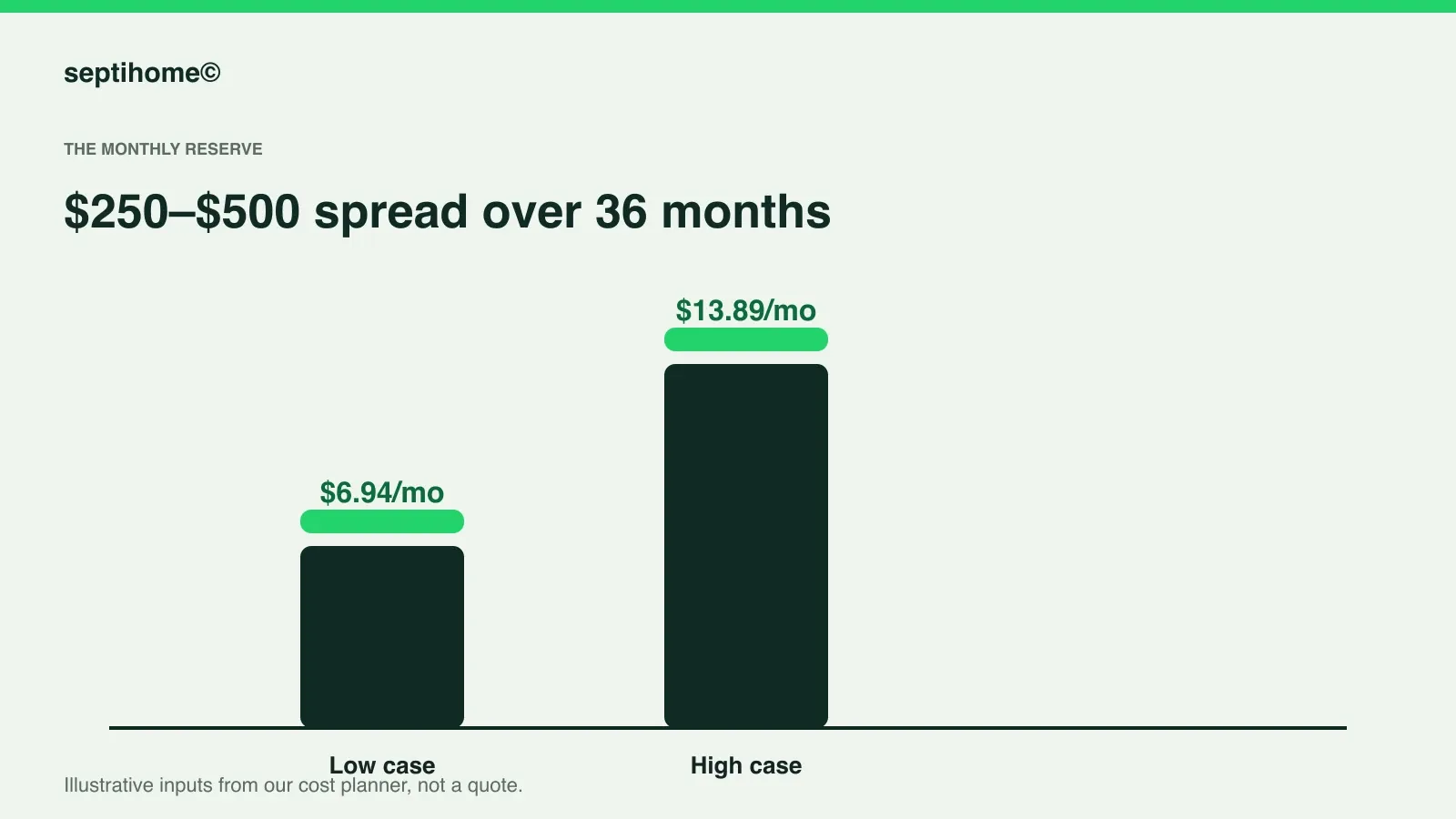 Monthly reserve chart for a 250 to 500 dollar pump-out
When paying more now saves money later#
Common advice says to pump only when the tank is full. The evidence says something different. The EPA ties timely pumping to the life of the drainfield, and drainfield repair or replacement costs far more than a pump-out.
The EPA puts conventional system repair at $5,000 to $15,000. Alternative systems cost more. Against that, a $250 to $500 pump-out every few years is the cheaper path.
{{IMG4}}
A second paid service is worth considering: an inspection with the pump-out. The inspector can see the baffles and the filter while the tank is open. Those are the parts that fail quietly.
If water backs up or the ground stays wet, the symptom checker helps you record what you see before you call.
When to pay for an inspection#
An inspection costs more than a pump-out, and it answers different questions. Pay for one when the system is new to you, when the tank has never been pumped, or when you plan to sell the house.
An inspector opens the tank, checks the baffles and the filter, and looks for signs of backup. The report records the scum and sludge levels and the condition of the pipes.
The EPA recommends an inspection every one to three years for a typical home. Pairing it with a scheduled pump-out saves a second visit fee.
 Brick house with a green front lawn where the tank sits
What to do with the record#
Write down five details before the truck leaves:
- The date and the company
- The tank size in gallons
- The scum and sludge levels the crew measured
- Whether the disposal fee was included
- The next suggested date
Keep the septic tank pumping cost receipt with your permit and any inspection reports. When you sell the house, that file answers the buyer's first question.
Why prices differ by region#
A pump-out in a rural county can cost more than the same job near a city. The reason is usually distance, not labour. Crews travel farther and pay more to reach a treatment plant.
Local rules matter as well. Some jurisdictions require a licensed hauler and a manifest for every load. That paperwork adds a small cost to each visit.
Neither factor says anything about the quality of the work. Compare the scope, not the postcode.
FAQ#
How much does it cost to pump a septic tank?#
A septic tank pumping cost of $250 to $500 is the EPA reference. Local quotes vary with tank size, access and disposal fees. Get two written estimates that include hauling and disposal.
Does a pump-out include an inspection?#
Usually not. A septic tank pumping cost usually excludes the inspection. A pump-out empties the tank. An inspection checks the baffles, filter, pipes and drainfield, and it is priced separately in most quotes.
How often should a tank be pumped?#
The EPA suggests every three to five years for a typical household. Inspect every one to three years. Household size and tank size move both intervals.
Can I pump the tank myself?#
No. Tank entry is a confined-space hazard, and the waste needs licensed hauling and disposal. Opening a tank without training risks serious injury.
Why is my quote higher than a neighbour's?#
Tank size, lid access, hose distance and disposal fees differ from one property to the next. A buried lid alone can add a large share to the visit. Compare line items, not totals.
Should I pump before selling a house?#
Many buyers ask for a recent pump-out and inspection. A dated record with the tank size and the measured levels answers that question. Check your state's disclosure rules as well.
Sources#
SeptiHome editorial uses linked public guidance and original tool examples. A licensed septic professional has not reviewed this guide. Local requirements, your system manual, and professional findings take priority.