
Pumping vs additives is a question with a short answer: an additive cannot remove solids, and pumping can.
The comparison is not close. It is still worth understanding, because the marketing for additives is written to make the two sound like alternatives.
This guide explains what a pump-out removes, what an additive claims and why the EPA does not recommend the products. It also explains why pumping vs additives is not a fair fight.
What pumping removes#
A pump-out removes what the tank cannot digest.
- Sludge from the bottom
- Scum from the top
- Some liquid with the solids
That material leaves the property. The working volume returns.
That is the whole service.
What an additive claims#
An additive claims to break waste down faster or to keep a system working longer.
The claims usually involve enzymes, bacteria or chemicals.
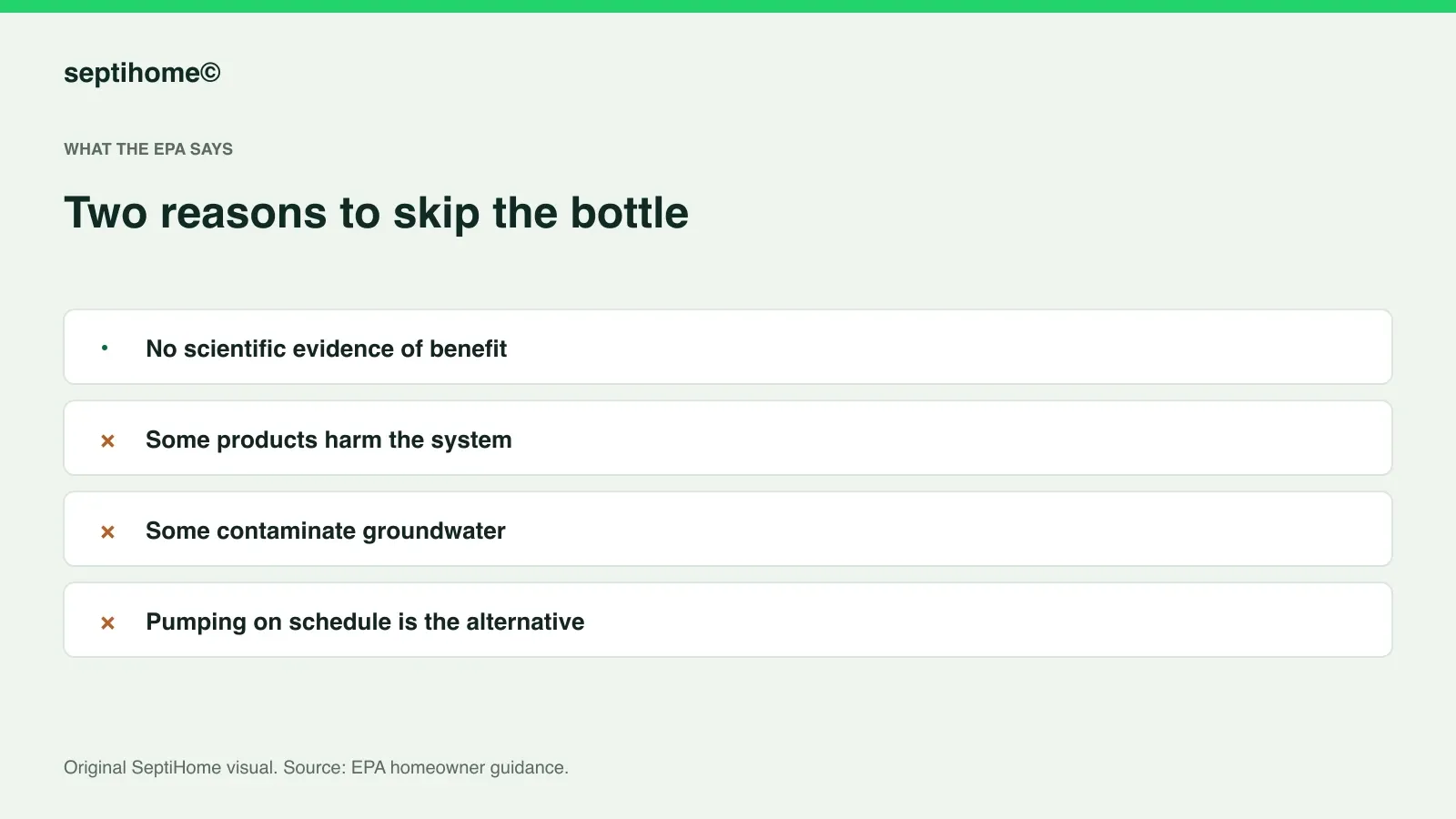
The EPA does not recommend septic system additives for domestic wastewater. It cites no scientific evidence of benefit and warns that some products can harm the system or the groundwater.
Pumping vs additives in one table#
| Question | Pump-out | Additive |
|---|---|---|
| Removes solids | Yes | No |
| Restores volume | Yes | No |
| Produces a record | Yes, with levels | No |
| Regulated service | Yes | No |
| EPA position | Recommended schedule | Not recommended |
The first two rows decide it.
What happens without pumping#
The scum and sludge layers keep growing.
The clear middle layer shrinks. Water has less time to settle before it leaves.
Solids travel to the field. The biomat thickens.
That sequence takes years. The end is a failed field.
What a provider sees#
A provider opens the tank and looks at the layers.
They measure the scum and sludge. The numbers show how close the tank is to the two-thirds line.
Pumping vs additives is settled in that moment: the solids are there, and only a truck removes them.
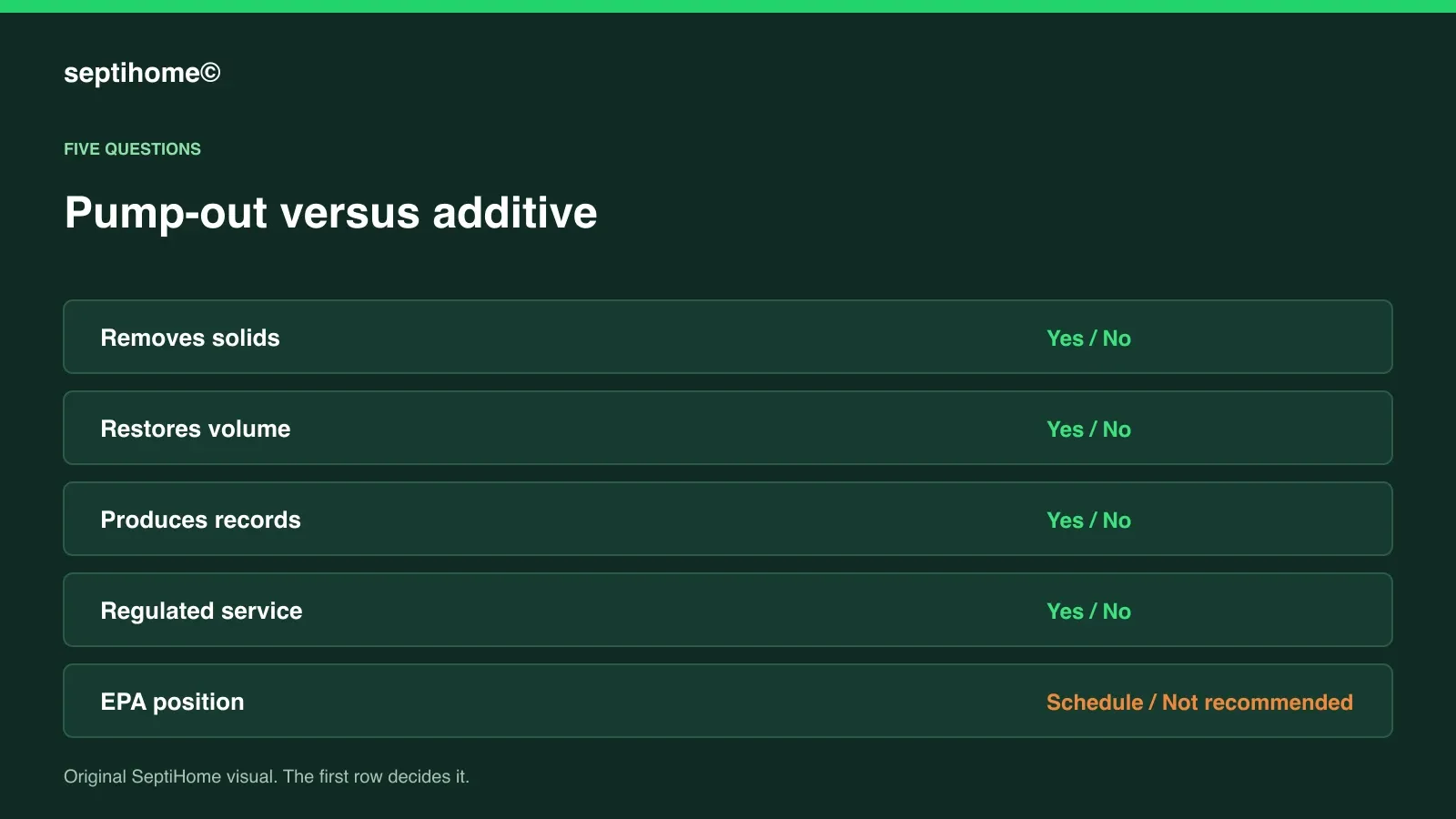 Chart of five questions comparing pump-out and additive
Why a product cannot do the job#
Solids settle. They accumulate. They do not disappear.
Bacteria break down part of the waste, but the fraction that remains is the fraction that fills the tank.
No additive can lift that material out of the tank. That is why pumping exists.
What the EPA says in full#
The EPA's guidance lists additives among the things not to use.
It gives two reasons: no evidence of benefit and possible harm.
It also gives the alternative: a maintained system, pumped on schedule.
That is the whole position. Pumping vs additives is not a close call in the guidance.
Why the products sell anyway#
A septic system is out of sight. A product promises control over something you cannot see.
The promise is cheap and the purchase is easy. That combination sells.
The additives article covers the claims and the evidence in more detail, and the pumping cost guide shows what the truck visit costs.
What a system actually needs#
A system needs solids removed, water managed and the field protected.
Products touch none of the three.
Service touches all three.
The maintenance guide walks through each one.
 List of EPA positions on septic additives
When an additive seems to help#
Three situations make a product look effective.
- A drain clears after a chemical pour
- A smell fades after a treatment
- A tank seems to last longer
Each has another explanation. A drain clears because the blockage moved.
A smell fades because the source changed. A tank lasts because it was maintained, not because of a bottle.
What the evidence supports#
The EPA's maintenance schedule is the evidence-based path.
- Pump every three to five years
- Inspect every one to three years
- Check the filter at each pump-out
- Keep solids and chemicals out of the drain
Those four lines are the plan. The maintenance checklist turns them into a routine.
What a pump-out records#
A pump-out produces a record: the date, the tank size and the measured levels.
That record predicts the next interval. No product produces one.
When the levels rise faster than expected, the record shows it. The product cannot.
What additives cost over a decade#
A monthly product costs money every month.
Over ten years, the total can approach a pump-out or more.
The money buys no measured outcome. A pump-out buys a date and two numbers.
Pumping vs additives for a failing field#
A field that has failed does not recover with a product.
The fix is an inspection, a pump-out, a rest period or a repair.
A product on a failed field delays the diagnosis, and the field keeps getting worse.
What to do instead#
Spend the product budget on the service.
If the goal is fewer pump-outs, the lever is water use and solids, not a bottle.
If the goal is a longer life, the lever is the field and the schedule.
What the record proves#
A pump-out leaves a record with numbers.
A product leaves a receipt.
When a buyer or an inspector asks what was done, the record is the answer.
Pumping vs additives is also a question about evidence, and only one side produces it.
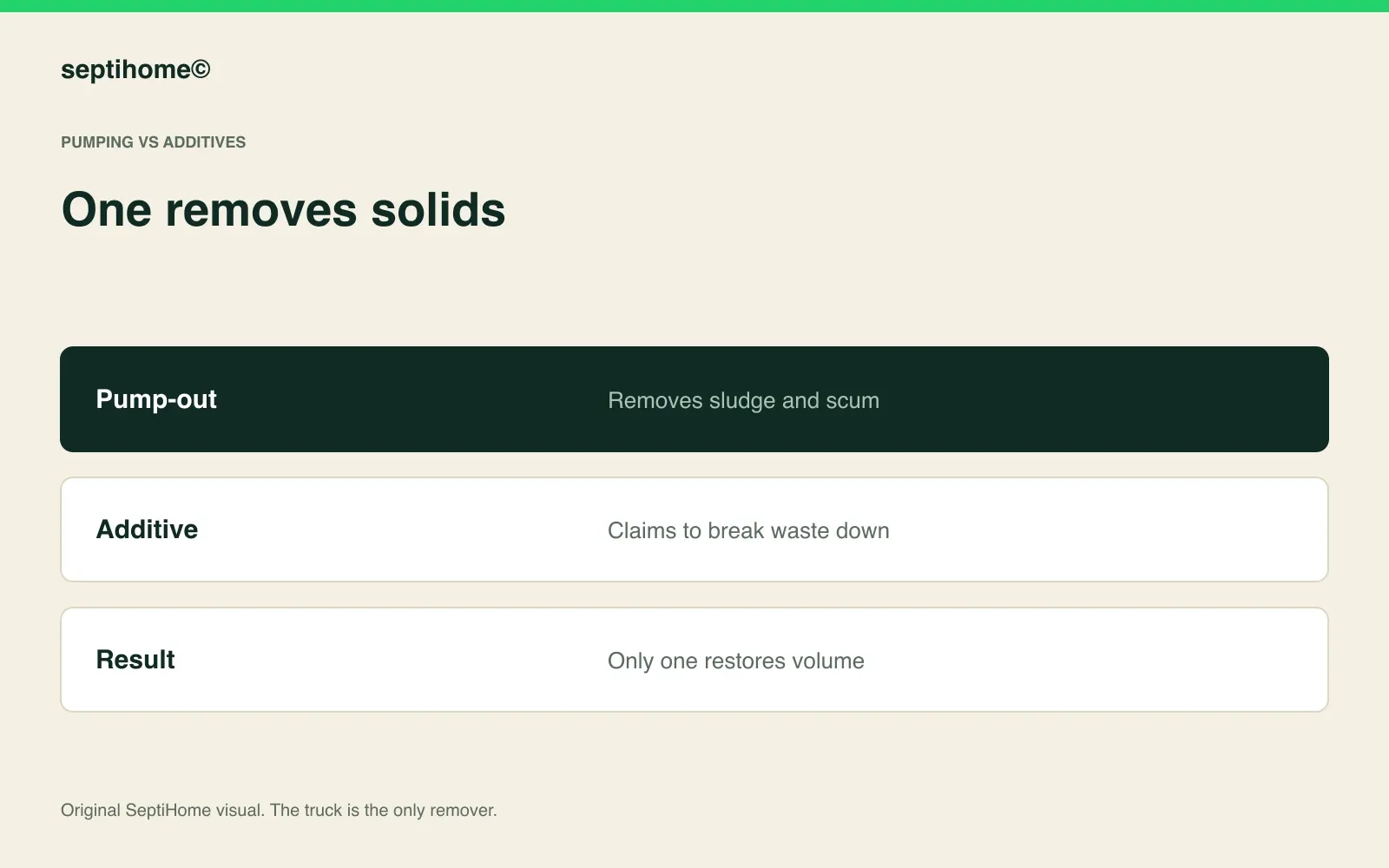 Chart comparing a septic pump-out with an additive product
A worked example: two households#
Two households have the same tank and the same start date.
The first buys a monthly additive and skips a pump-out. The second saves the money and pumps on schedule.
At year eight, the first has a full tank and a soft patch. The second has a record and a working field.
This example is illustrative. The schedule is the difference.
What a buyer should ask#
A buyer should ask for the last pumping date and the levels.
A seller who used additives but has no pumping record has nothing to show.
That gap is the answer to pumping vs additives in one question.
What a renter should do#
A renter can stop buying products and report problems.
The landlord owns the service. The renter owns the habits.
Both sides benefit from the schedule.
What the schedule looks like#
Write the next date and keep the record.
The date is the plan. The record is the proof.
Nothing on a shelf replaces either.
FAQ#
Can additives replace pumping?#
No. A pump-out removes solids; an additive cannot.
Do septic additives work at all?#
The EPA says there is no scientific evidence that they aid decomposition, and some can harm the system or groundwater.
What if I already use additives?#
Stop buying them and book the pump-out. Tell the provider which product you used.
Is pumping vs additives a cost question?#
Partly. The product costs money monthly and produces no record. The pump-out produces both.
Sources#
SeptiHome editorial uses linked public guidance and original tool examples. A licensed septic professional has not reviewed this guide. Local requirements, your system manual, and professional findings take priority.