
A septic maintenance checklist turns a vague worry into a short list of jobs. The list below covers a typical household and one page. Most of it takes minutes, and one item runs on a multi-year clock.
The EPA's guidance gives the frame: inspect every one to three years, pump every three to five, and protect the drainfield every day in between.
This septic maintenance checklist is built for a typical household. Add local rules and your provider's advice where they differ.
The monthly checklist#
Five habits keep solids and water load under control.
- Flush only human waste and toilet paper
- Keep grease, wipes and chemicals out of the drain
- Fix running toilets and dripping taps
- Spread laundry through the week
- Keep the lid and riser clear of soil and plants
None of these takes long. Each one keeps the tank from filling faster than it should.
The seasonal checklist#
A few jobs suit the change of season.
| Season | Check | Why |
|---|---|---|
| Spring | Look for wet ground over the field | Spring water tables rise |
| Summer | Check the grass over the field | Bright stripes can mean effluent |
| Fall | Clear leaves from the lid area | Leaves hide access and hold moisture |
| Winter | Keep snow off the lid, not packed on it | Access and insulation matter |
A seasonal walk costs nothing and catches problems early.
What the water habits protect#
A checklist item is only useful if it protects something. The toilet and laundry habits protect the tank's working volume.
A running toilet can send hundreds of gallons a day into the tank. A laundry marathon on Sunday does the same in an afternoon.
The EPA recommends spreading laundry through the week and fixing leaks. Those two habits are the highest-value lines on any septic maintenance checklist.
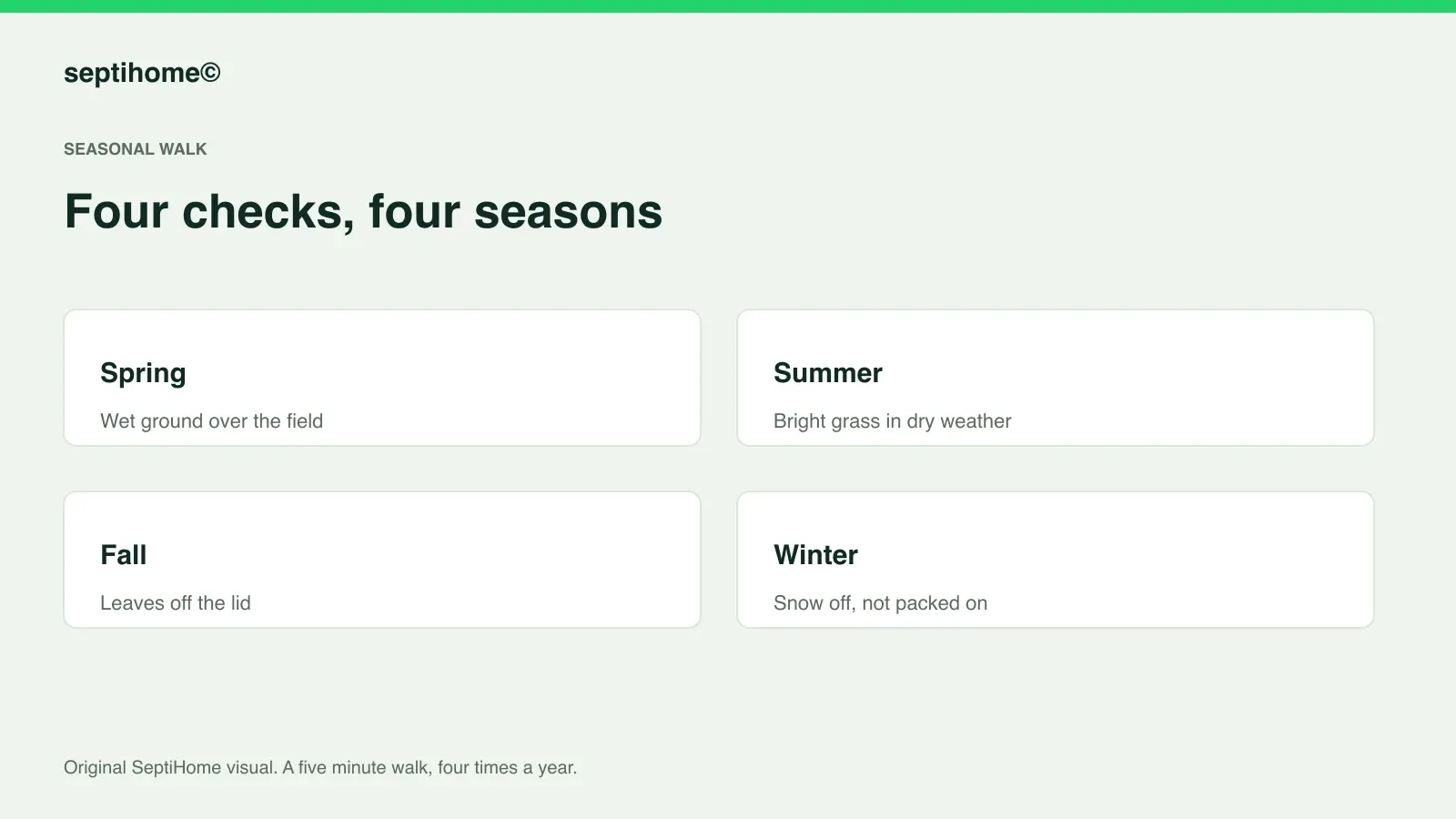 Chart of four seasonal checks for a septic system
The yearly checklist#
Once a year, run a longer septic maintenance checklist over the whole system.
- Find the last pumping and inspection dates
- Check the filter if it is accessible
- Look for cracks in the lid and riser
- Confirm the alarm still works on an alternative system
- Update the record
If the last inspection is more than three years old, book one. If the pumping date is unknown, treat the tank as overdue.
Why this septic maintenance checklist is short#
A septic maintenance checklist looks too simple for a system that costs thousands. That is the point.
The tank does the work. The homeowner protects the conditions: waste, water and access.
Everything else is a provider job with a date attached. Keeping the list short makes it likely to happen.
A long list of things you cannot check is not maintenance. It is decoration.
The multi-year checklist#
Two items run on the long clock.
- Pump the tank every three to five years
- Inspect the system every one to three years
The EPA sets those intervals. Household size, water use and tank size move them, so use the measured levels to choose where you land.
What to check on an aerobic system#
An aerobic system adds parts: an air pump, a control box, maybe a sprinkler. The checklist grows with them.
- Listen for the air pump and confirm it runs
- Check the alarm panel light
- Keep the vents clear of snow and plants
- Confirm the sprinkler heads are not blocked
The EPA suggests an annual inspection for systems with pumps or controls. Put that date on the multi-year line.
What a complete record holds#
A septic maintenance checklist is only useful with a record behind it.
| Record | Why keep it |
|---|---|
| Permit and drawing | Shows layout and tank size |
| Pumping receipts | Show dates and measured levels |
| Inspection reports | Show condition over time |
| Service contracts | Show what a provider covers |
Keep them in one folder. The maintenance planner holds the dates, and the maintenance guide explains the intervals.
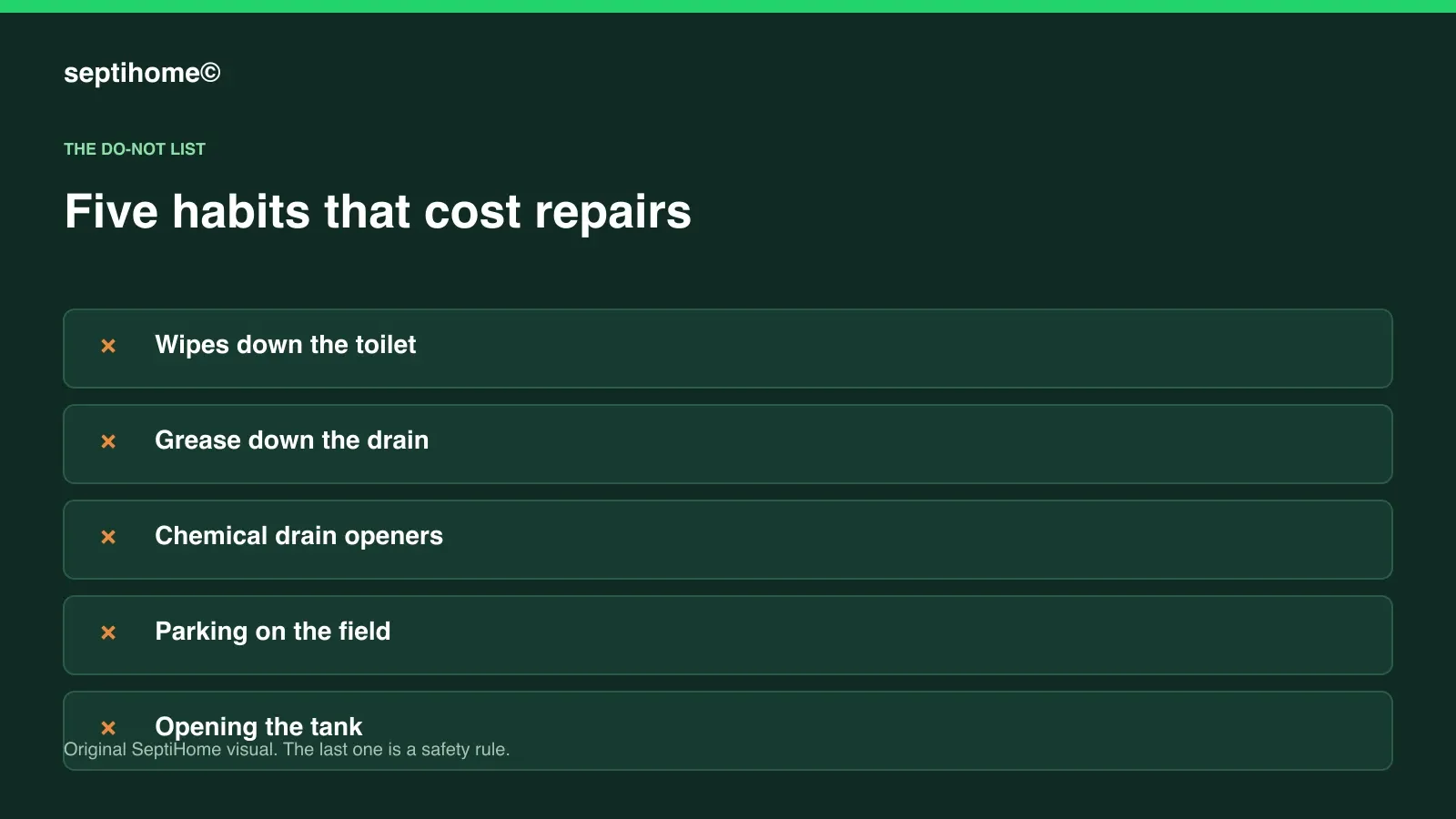 Chart of five habits to avoid around a septic system
The do-not list#
Some habits cause most of the repairs.
- Do not flush wipes, paper towels or cat litter
- Do not pour grease or cooking oil down the drain
- Do not use chemical drain openers
- Do not park or drive on the drainfield
- Do not plant trees close to the field
- Do not open the tank or enter it
The last one is a safety rule, not a maintenance preference. Tank gases can be deadly.
When to stop the checklist and call#
Some symptoms do not wait for the next scheduled item.
- Sewage backs up into the house
- Wastewater surfaces outside
- The alarm sounds with no draining
- A strong smell appears near the tank
Stop water use, keep people clear, and call a professional. The symptom checker organizes what to record before the call.
A septic maintenance checklist prevents problems. It does not replace an emergency call.
 Hands holding a home inspection checklist on a clipboard
Photo: RDNE Stock project, Pexels
How to use this checklist#
Start the septic maintenance checklist with the monthly items, because they are the easiest to adopt.
Then put the yearly items on a calendar. Finally, add the multi-year dates with the cost planner beside them so the budget matches the schedule.
A checklist on a fridge beats a perfect plan in a drawer. Pick three items this week and add the rest next month.
What the checklist does not cover#
A homeowner list cannot check the baffles, the filter or the field. Those need the tank open and someone who knows what to look for.
It also cannot measure the scum and sludge levels. A provider records those at each pump-out.
The checklist's job is to get the right person there on time, with the dates in hand. The inspection does the rest.
FAQ#
How often should the checklist be done?#
The monthly habits run continuously. The seasonal walk happens four times a year, the yearly review once, and the pump-out every three to five years.
Do I need a professional for every checklist item?#
No. The habits and the seasonal walk are homeowner jobs. Inspections, pumping and electrical work belong to a provider.
Can I print this checklist?#
Yes. Each section works as a printed list, and the record table fits on the same page. A paper copy in the house file is enough, and a phone photo covers the weeks when the folder is at the office.
What if I miss a year?#
Nothing breaks immediately. Book the missed service and restart the calendar; the measured levels tell you whether the delay mattered.
Where should I keep the checklist?#
With the permit and the pumping records. A paper copy in the house file and a photo on a phone both work.
Sources#
SeptiHome editorial uses linked public guidance and original tool examples. A licensed septic professional has not reviewed this guide. Local requirements, your system manual, and professional findings take priority.