
A septic tank alarm is a warning, not a diagnosis. It tells you the system needs attention before wastewater backs up. The alarm does not tell you which part failed, and it does not price the repair.
Most alarms sit on systems with a pump, a float or a control panel. A conventional gravity system often has no alarm at all.
This guide explains what triggers a septic tank alarm and what to do in the first ten minutes. It also covers what to record so the service visit starts with facts.
What a septic alarm is#
A septic alarm is a light and a sound on a control panel. It warns that a condition has passed a set point.
For a septic tank alarm, the most common trigger is a high water level in a pump tank. The pump has not moved water, or water arrived faster than it could leave.
The second most common is a pump fault: a tripped breaker, a stuck float or a failed pump.
The alarms you may meet#
Three alarm types cover most homes.
- High-level alarm on a pump tank
- Pump or control fault alarm
- Air or blower alarm on an aerobic system
Each one points to a different part of the system. The panel wording is the clue.
A septic tank alarm usually names its cause on the panel. Read it before you call. A label that says "high water" tells the provider what to bring.
Why a pump tank has an alarm#
A pump tank holds treated water until a pump moves it to the drainfield or a mound. The tank has a float that starts the pump at a set level.
If the level keeps rising, a second float triggers the alarm. The alarm is the last warning before water has nowhere to go.
That is why the alarm matters. It fires while there is still room to act.
What the alarm looks like#
Panels vary, but most use the same signals: a red light, a buzzer and a label.
Some panels show a small display with a code. Others show a single "alarm" light next to a printed list of causes.
The exact wording matters more than the color. Write it down.
Alarm and backup are not the same#
A septic tank alarm can sound before anything backs up. That is the point of the warning.
A backup means water has already reached the fixtures. The alarm is earlier in the sequence.
Treat the alarm as the cheap moment to act.
What to tell the provider about access#
Give the provider the lid location, the gate code and the tank size. Mention any deck, fence or vehicle in the way.
Access decides how long the visit takes, and a clear path keeps the cost down. A clear path means the crew spends its time on the fault.
What the panel buttons do#
Most panels have three controls.
- A silence button, which stops the sound but not the fault
- A test button, which checks the light and buzzer
- A reset or alarm reset, which clears the alarm after a fault is fixed
The silence button is not a repair. Pressing it buys quiet while the tank keeps filling.
Use the test button once a year, when the system is otherwise quiet. It confirms the alarm still works.
What not to do when the alarm sounds#
Four mistakes make an alarm worse.
- Do not open the tank lid to look inside
- Do not keep using water and hope the pump catches up
- Do not reset the alarm repeatedly without a fix
- Do not pour additives or chemicals into the system
A tank is a confined space. The gases inside can be deadly, and the water is a health risk.
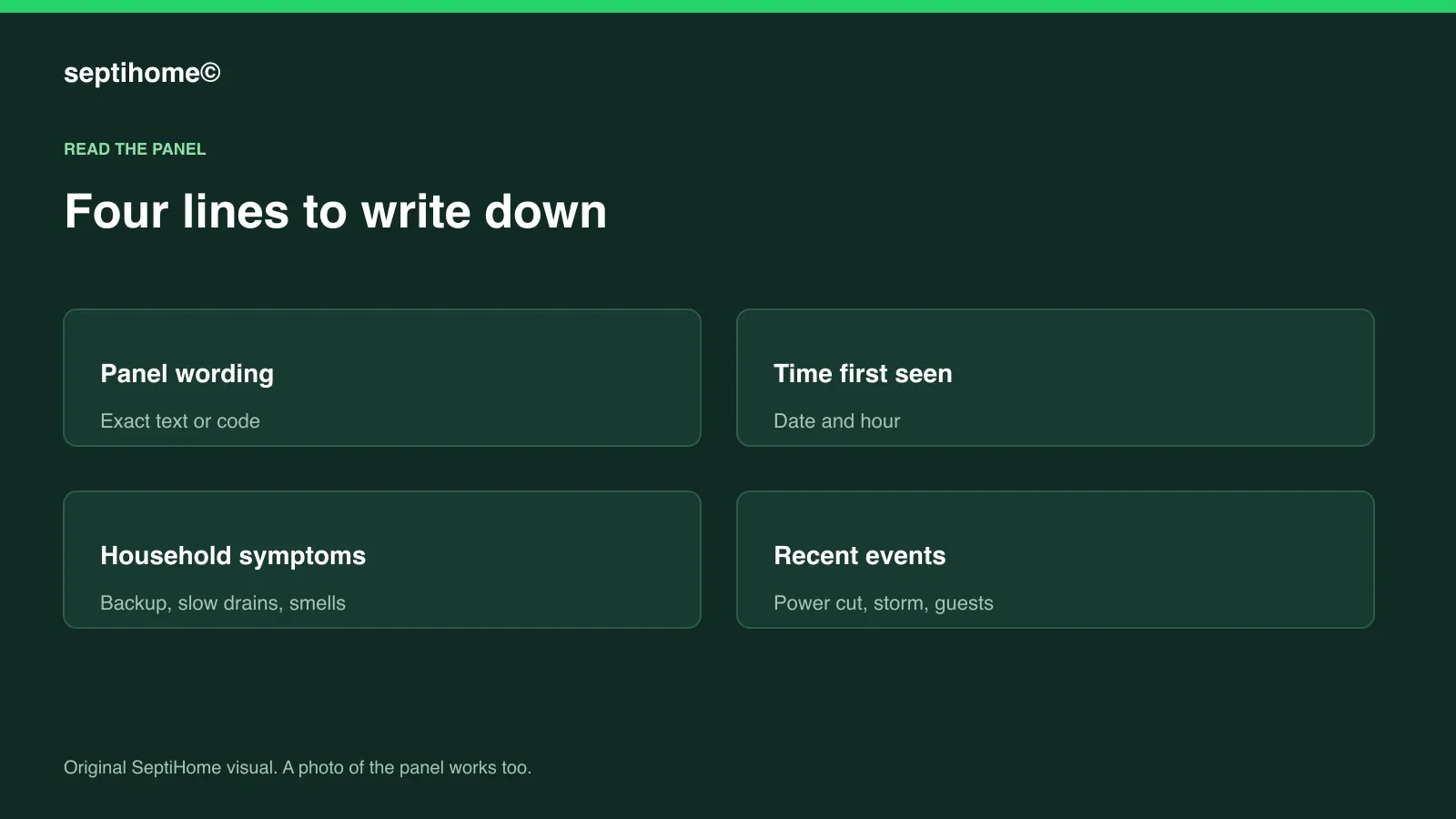 Chart of four details to record from an alarm panel
What to do in the first ten minutes#
Act in a fixed order. The order protects people first and the system second.
- Stop using water. Every flush adds volume to a system that is already behind.
- Keep people and pets away from the tank area. Do not open the lid.
- Read the panel and write down the exact wording, light or code.
- Note the time you first saw it.
- Call the system's service provider.
If wastewater is surfacing or backing into the house, treat it as an emergency. Use the pumping cost guide only after the emergency is handled. The symptom checker organizes the call.
What to record#
A useful record has four lines. The provider can price and prepare from them.
| Field | What to write | Why it matters |
|---|---|---|
| Panel wording | The exact text or code | Narrows the fault |
| Time first seen | Date and hour | Shows how long pressure built |
| Household symptoms | Backup, slow drains, odors | Separates alarm from failure |
| Recent events | Power cut, storm, visitors | Explains load or faults |
A photo of the panel works too. Take it from a safe, dry position.
Alarms on aerobic systems#
An aerobic system adds an air pump and often a sprinkler. Its panel may alarm for air pressure, pump faults or high water.
The air pump runs continuously. If it stops, the bacteria that need oxygen stop working, and the system loses its treatment capacity.
Check that the air pump is running and that its vent is clear. Do not open the tank to investigate.
What the provider will ask on the phone#
A good dispatcher asks four questions.
- What does the panel say?
- When did the alarm start?
- Is anything backing up or surfacing?
- Has the power been interrupted recently?
The answers decide whether the visit is urgent or scheduled. They also decide which parts the truck carries.
What the alarm does not tell you#
A septic tank alarm does not name the failed part, the repair cost or the urgency. It reports a condition.
That is why the record and the phone call matter. The provider turns the condition into a diagnosis.
The homeowner's job is to preserve the evidence and stop adding water. The provider's job is the rest, and the calmer the record, the faster that job goes.
What a repair usually involves#
Most alarm visits end with one of four fixes.
- A float that needs adjustment or replacement
- A pump that needs replacement
- A breaker or control board that needs repair
- A blockage in the discharge line
Ask for the failed part, the replacement and the warranty in writing. Add the date to the record.
What ignoring an alarm costs#
The EPA puts conventional system repair at $5,000 to $15,000. An ignored pump alarm can lead to a flooded field and a bill in that range.
A pump replacement is far cheaper than a drainfield repair. The septic tank alarm is the chance to keep the cost small.
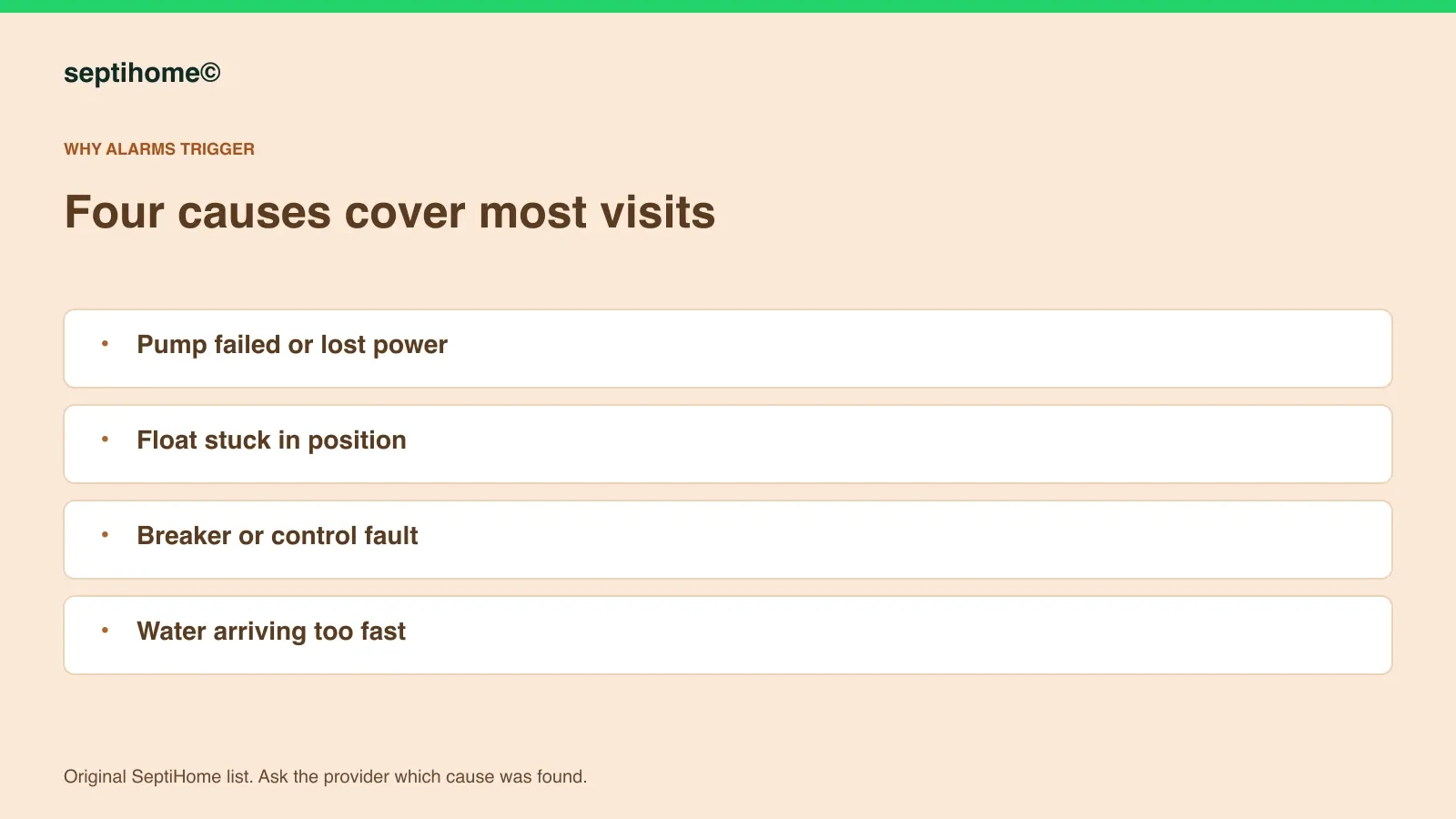 List of four common causes of a septic tank alarm
When a septic tank alarm is an emergency#
A septic tank alarm alone is a warning. An alarm with symptoms is an emergency.
- Sewage backs up into a fixture
- Wastewater surfaces outside
- The alarm sounds and nothing drains
- A child or pet has touched wet ground
Stop using water and call. Do not wait for a weekday if any of those is true.
Why alarms trigger#
Four causes explain most septic tank alarm visits.
- A pump that has failed or lost power
- A float stuck in position
- A tripped breaker or a control fault
- Water arriving faster than the system can move it
Heavy rain, a house full of guests or a backed-up laundry day can all push a marginal system over its limit.
What happens on the service visit#
The provider checks the panel first, then the floats and the pump. They may empty the pump tank and test the pump under load.
Ask what failed and what was replaced. Write both in the record, with the date.
If the fix is a new pump, ask about the warranty and the expected service life. That number belongs in your budget.
Preventing the next alarm#
Three habits reduce repeat alarms.
- Spread water use through the day
- Keep the panel clear and dry
- Book the annual inspection that alternative systems need
A pump that runs less often lasts longer. A panel that stays dry avoids false alarms.
The record that makes alarms cheaper#
A septic tank alarm costs less when the provider arrives knowing the system. Keep the tank size, the panel wording and the service history in one place.
The maintenance planner holds the inspection dates. The maintenance guide explains the schedule around them.
 Close-up of outdoor electrical utility boxes and wiring
Photo: panumas nikhomkhai, Pexels
A worked example: one alarm, two households#
Two homes have the same aerobic system. Both alarms sound on a Sunday.
The first owner stops water, photographs the panel and calls the provider with the wording. The provider arrives with the right pump and finishes in one visit.
The second owner resets the alarm and keeps using water. By Monday the tank is high, the field is loaded and the visit costs more.
Same alarm, different response. The record and the first ten minutes decided the cost.
Testing the alarm safely#
The panel's test button checks the light and the buzzer without touching the tank.
Do it once a year and note the date. If the buzzer is silent or the light is out, book a service call.
Do not test by raising the float by hand. That means opening the tank.
How often alarms become repairs#
Most alarms are a float, a pump or a control fault. A few are a symptom of a full tank.
The provider's first job is to separate the two. A full tank needs pumping; a pump fault needs a part.
That is why the record matters. A septic tank alarm with a pumping date and measured levels tells the provider where to start.
Can I turn the alarm off?#
Silence it, do not disable it. The alarm is the system's only warning.
Will insurance cover an alarm repair?#
Homeowner policies vary. Call your insurer before approving the work and ask what documentation they need.
FAQ#
What does a septic alarm mean?#
A septic tank alarm warns that a set point was passed, usually a high water level or a pump fault. It does not identify the failed part.
Can I reset the alarm and keep using water?#
No. Resetting hides a warning that will return. Stop water use and call the provider.
How long can a system run with the alarm on?#
It depends on the cause and the remaining capacity. Treat a sounding alarm as a reason to stop water use until the provider advises.
Do all septic systems have alarms?#
No. Alarms usually sit on systems with pumps or controls. A conventional gravity system may have none.
Sources#
SeptiHome editorial uses linked public guidance and original tool examples. A licensed septic professional has not reviewed this guide. Local requirements, your system manual, and professional findings take priority.